
CFD Trading in South Africa: What It Is and How It Works
Written by JP Markets | Published:
CFD trading lets you speculate on a market’s price movements without owning the asset. A CFD, or contract for difference, is an agreement with a broker to settle the change in price between when you open and close a trade. CFDs are leveraged and high-risk: small price moves can lead to large losses, and you can lose more than the margin you put down.
If you’re exploring CFD trading in South Africa, this guide explains the key terms, costs and risks. It also walks through examples in rand and the steps involved in placing a trade. It’s written for new traders and for experienced traders who want to check the numbers.
Key takeaways
- CFDs are high-risk. Leverage means you can lose money quickly, and your losses can exceed your margin.
- A CFD is a contract based on an asset’s price. You don’t own the asset.
- You can go long if you think the price may rise, or short if you think it may fall.
- Leverage lets you open a larger position with a smaller deposit, called margin. It can magnify losses as well as gains.
- Trading costs may include the spread, commission, overnight financing, and currency conversion.
- Decide how much you can afford to risk before opening a trade.
What Is CFD Trading?
A CFD is a derivative product that allows you to speculate on the price movement of an instrument without owning it. CFD stands for contract for difference. You and the broker agree to settle the difference between the price when you open a trade and the price when you close it.
Say you open a CFD trade on a specific stock with a share price of R100. You haven’t bought the share; you’ve opened a contract based on its price. If you close the trade at R110, the price has risen by R10. If you close at R95, it has fallen by R5. Your profit or loss depends on that price change, your position size, and any trading costs.
That’s the basic CFD trading meaning: you trade the price movement, not the asset itself. If you’re trading a share CFD, you don’t have the same rights as those who invest in stocks; for example, you don’t become a shareholder, the shares aren’t held in your name, and you don’t receive shareholder voting rights.
CFDs also let you trade on falling prices. If you think a market may rise, you can buy or go long. If you think it may fall, you can sell or go short. Both positions carry risk: if the market moves against you, you can lose money.
The contract is between you and the broker, so read the product and account terms before opening a position.
CFD Trading Glossary: Key Terms to Know
You’ll see these terms on trading platforms and in account documents. Here’s what they mean in everyday language.
- Underlying asset
- The share, index, currency pair, commodity, or other market that a CFD is derived from.
- CFD
- A contract for difference. You settle the price change with the broker; you don’t own the underlying asset.
- Long
- A position that may gain value if the price rises.
- Short
- A position that may gain value if the price falls.
- Exposure
- The full market value of your position. Your profit or loss is generally calculated from the exposure, not just your margin.
- Leverage
- Using margin to open a position with more market exposure than the funds you put down. It can increase losses as well as gains.
- Margin
- Funds required to open and maintain a leveraged position. It isn’t the maximum you could lose.
- Equity
- Your account balance plus or minus the unrealised profit or loss on open trades.
- Margin level
- Your equity divided by the margin in use, shown as a percentage. Brokers use it to decide when to warn you or close positions.
- Margin call
- A warning that your equity has fallen close to the margin in use. It doesn’t guarantee time to add funds.
- Stop-out
- A broker’s process for closing positions when account equity falls below a specified level. The rules depend on the broker’s terms.
- Bid
- Usually, the price at which you can sell.
- Ask
- Usually, the price at which you can buy.
- Spread
- The difference between the bid and ask prices. It’s one possible cost of a trade.
- Point / pip
- The unit used to measure a price movement. Its cash value depends on the contract specifications.
- Lot
- A unit of position size. Its size varies by instrument and broker.
- Swap / overnight financing
- A debit or credit that may apply if certain CFD positions stay open overnight.
- Stop-loss order
- An instruction to close a position at a set level, intended to limit loss. In fast or gapping markets, it may not execute at exactly that price.
- Slippage
- The difference between the price you requested and the price at which your order is executed.
If you’re unsure what a number on an order ticket means, pause and check the product specifications.
How CFD Trading Works
A CFD trade has three basic parts: the market price, your position size, and your direction. Your result depends on the price change between opening and closing, multiplied by the value of each point, pip, or unit in your position.
Position size is often measured in lots, which represent a specific quantity of an underlying asset or a set number of CFD units. The size of a lot varies depending on the instrument and the broker's contract specifications. Trading a larger lot size increases your market exposure, meaning each price movement can have a greater impact on your profit or loss.
The contract specifications tell you what a price movement is worth. This value varies between instruments and brokers. A 10-point move in one CFD may have a different cash value from a 10-point move in another. Understanding the relationship between lot size, position size, and the value of each price movement helps you estimate your potential profit or loss before opening a trade.
Going Long vs Going Short
When you go long, you buy a CFD because you think the price may rise. When you go short, you sell a CFD because you think it may fall.
Going short doesn’t mean you’ve borrowed and sold the underlying asset in the same way as some traditional short-selling arrangements. You’ve entered a CFD contract, and its value changes as the market price moves.
For example, if you open a short CFD position on an index at 5,000 points and the price falls to 4,950 points, the 50-point move is in your favour. If the price rises to 5,050 points instead, the 50-point move is against you. Your actual profit or loss depends on your position size, the value of each point, and any applicable trading costs.
Buy / go long
Your view: the price may rise.
- May help
- Price rises
- May hurt
- Price falls
Sell / go short
Your view: the price may fall.
- May help
- Price falls
- May hurt
- Price rises
Leverage and Margin Explained
Leverage is a way to open a position worth more than the capital you set aside for it. It’s shown as a ratio, such as 1:100. At 1:100 leverage, R1,000 can support a CFD position worth R100,000. Margin, on the other hand, is the amount required to open the position. In other words, the R1,000 that supports the R100,000 position is the margin.
Here’s how the figures work for a R100,000 CFD position at 1:100 leverage:
To calculate the margin, divide the position value by the leverage ratio:
R100,000 ÷ 100 = R1,000 margin
Once the trade is open, the R100,000 position value is used to calculate your profit or loss. If you’re in a long position and the market rises by 1%, the position gains R1,000 before costs. If the market falls by 1%, it loses R1,000 before costs. If you’re in a short position, those outcomes are reversed. At 1:100, a 1% move against you equals your entire R1,000 margin.
The R1,000 margin doesn’t limit your possible loss to R1,000. It’s the amount required to open the trade. Your account’s equity changes as the position gains or loses value. If it falls too low, your broker may issue a margin call, which is a warning to add funds or reduce your positions. If equity keeps falling, it may close positions automatically, which is a stop-out. The broker’s margin rules explain when each can happen.
The required margin depends on the instrument and the leverage available for it. A higher leverage ratio means less margin is needed for the same position, but the position’s value and the amount gained or lost from a given price move stay the same. Trading costs, such as spreads and overnight financing, could also affect the result.
How to Read a CFD Quote: Bid, Ask and Spread
A CFD quote usually shows two prices: the bid and the ask.
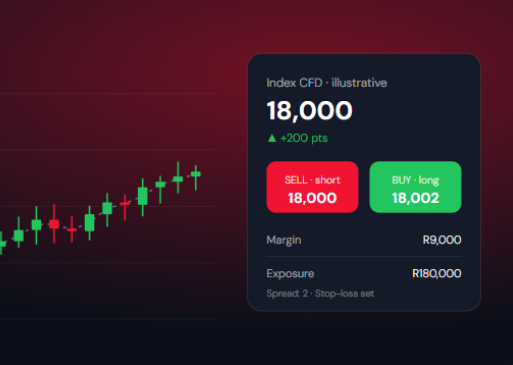
For example, if you see 18,000 / 18,002, the spread is 2 pips. A long/buy trade opens at the ask; a short/sell trade opens at the bid. So, when you first open a trade, its value may show a small loss equal to the spread. The price needs to move far enough to cover that cost before the position shows a profit, all else being equal.
Quotes may be shown in points, pips, cents or another unit. Check the platform’s quote format and the contract specifications for your chosen instrument.
How CFD Profit and Loss Is Calculated
A simplified calculation is:
Profit or loss = price movement × value per point × number of contracts
For a long trade, subtract the opening price from the closing price. For a short trade, subtract the closing price from the opening price. Then multiply by the contract value and position size.
Long: (closing price − opening price) × value per point × number of contracts
Short: (opening price − closing price) × value per point × number of contracts
The result is before costs. These may include the spread, commission, overnight financing and currency conversion.
CFD Trading Example: A Worked Trade in Rand
The examples below use made-up contract values, margin rates and fees to show how the calculations work. They aren’t live JP Markets prices or terms. Actual contract sizes, margin requirements and costs vary by product and broker. Check the current instrument specifications before trading.
Example 1: Going Long on a Nasdaq Index CFD
Suppose you think the Nasdaq index may rise, so you buy one CFD at 18,000. For this example, assume:
- One contract is worth R10 per index point.
- The margin rate is 5%.
- The index rises to 18,200.
- You close the trade at that price.
- Spread, commission and financing are excluded.
- 1. ExposureR180,00018,000 × R10 per point
- 2. MarginR9,000R180,000 × 5%
- 3. Price move200 points18,200 − 18,000
- 4. Gross resultR2,000200 × R10, before costs
You put down R9,000 margin to open a position with R180,000 exposure. Your result came from the 200-point price move multiplied by R10 per point. If the index had fallen by 200 points instead, the gross result would have been a R2,000 loss. That R2,000 loss would be about 22% of the R9,000 margin.
This example uses a simplified rand value per point. A real Nasdaq CFD may be quoted or settled in another currency, and its contract value may be different. Check the specifications and account currency before trading.
Example 2: Going Short on USD/ZAR
Suppose you think the rand may strengthen against the US dollar. In this example, you expect USD/ZAR to fall, so you sell one CFD representing US$1,000 at R18.50 per US dollar.
Later, the rate falls to R18.20, and you close the trade.
Price movement: R18.50 − R18.20 = R0.30 per US dollar
Gross result: R0.30 × US$1,000 = R300 gross profit
The rand strengthened in this example because fewer rand were needed to buy one US dollar. The short position gained value as USD/ZAR fell.
Now let’s include an overnight financing debit. Assume, purely for illustration, the broker charges R35 for holding the position for one night:
R300 gross profit − R35 financing = R265, before spread, commission or other costs.
Now consider the opposite outcome. If USD/ZAR had risen to R18.80 instead, the price would have moved R0.30 against you:
Gross result: −R0.30 × US$1,000 = R300 gross loss
R300 gross loss + R35 financing = R335 loss, before spread, commission or other costs.
Financing doesn’t only reduce a profit. On a losing trade, it adds to the loss.
The R35 is not a current JP Markets swap rate. Depending on the instrument and direction, financing can be a debit or a credit. When South African interest rates are higher than US rates, a short USD/ZAR position may receive a financing credit, depending on the broker’s rates. Financing charges can change and depend on the instrument, direction, position size, holding period, and broker’s terms. Check the current JP Markets swap rates and contract details before leaving a position open overnight.
Example 3: When a Trade Goes Against You
Let’s return to the Nasdaq example. You buy one CFD at 18,000. The contract is worth R10 per point and requires R9,000 margin. This time, your account balance is R15,000, and the index falls to 17,800.
- Floating loss−R2,000(17,800 − 18,000) × R10
- Account equityR13,000R15,000 − R2,000
- Margin level144%R13,000 ÷ R9,000 × 100
Equity is your account balance, adjusted for the unrealised gain or loss on open trades. Margin level compares that equity with the margin currently in use. Brokers use their own rules to decide when they’ll send a margin warning or close a position.
For illustration, imagine a broker’s margin-call level is 100%, and its stop-out level is 50%. With R9,000 margin in use:
- A 100% margin level would mean equity has fallen to R9,000. With this trade, that would happen if the index fell to about 17,400, a 3.3% drop from your entry.
- A 50% margin level would mean equity has fallen to R4,500. That would happen at about 16,950, a 5.8% drop.
In other words, with this account, a fall of less than 6% in the index could see the position closed automatically.
These thresholds are hypothetical, not JP Markets’ live terms. The broker’s policy determines what happens, including which positions may be closed and when. A margin warning doesn’t guarantee extra time to add funds. A stop-loss can set a planned exit, but in a fast or gapping market it may not execute at the exact price you chose.
What Are the Risks of CFD Trading?
The main risks are leverage, margin calls and stop-outs, market gaps and slippage, counterparty risk, and losses that exceed your margin. Leverage can make losses build quickly.
Leverage Risk
A leveraged trade exposes you to a larger market value than the margin you put down. This magnifies the effect of a price move on your account.
In the Nasdaq example, R9,000 margin supported R180,000 exposure. A 1% move in the exposure equals R1,800. If the move is against your position, that’s a loss of R1,800 before costs. The margin isn’t the maximum you can lose. That’s 20% of your margin. A 5% move against you would equal the full R9,000.
Margin Calls and Stop-Outs
If a trade loses value, your account equity falls. If it gets too low compared with the margin in use, the broker may issue a margin call (a warning) and, if equity keeps falling, close positions under its stop-out policy.
The warning level, stop-out level and order in which positions are closed depend on the broker’s terms. Read those rules before trading. Don’t assume you’ll have time to add funds or close the position yourself.
Market Gaps and Slippage
A market gap happens when the next available price differs from the previous one, with no trading at the prices in between. Gaps can occur around market openings, news, or unexpected events.
Slippage is the difference between the price you requested and the price at which your order is executed. It can happen when prices move quickly, or there isn’t enough liquidity at your requested price. A stop-loss may not execute at exactly the level you set unless the broker offers a guaranteed stop and you meet its conditions.
Counterparty Risk
Many CFDs are over-the-counter (OTC) contracts between you and the provider, rather than contracts traded on a central exchange. The broker is your counterparty or arranges execution under the terms of the product.
Read the broker’s legal documents. Check how trades are priced and settled, how client funds are handled, and how complaints are managed. Authorisation is an important part of choosing a broker, but it doesn’t remove trading risk or guarantee a profit.
Losses Can Exceed Your Margin
Your margin is only the amount needed to open a position. If the market moves sharply, particularly through a gap, your losses can exceed the margin in use and, depending on your account terms, your account balance. A short position carries a theoretically unlimited loss, because there’s no limit to how far a price can rise.
What Markets Can You Trade with CFDs?
The markets available depend on your broker and account. CFDs may follow prices in several asset classes.
Forex CFDs
A forex CFD follows a currency pair, such as USD/ZAR or EUR/USD. The first currency is the base currency; the second is the quote currency. USD/ZAR shows how many rand are needed to buy one US dollar.
Currency prices can respond to interest rate expectations, economic reports, political events and changes in demand. These influences can produce sharp moves, particularly around major announcements.
Index CFDs
An index CFD follows a stock-market index, such as the JSE Top 40, Nasdaq-100 or S&P 500. You’re trading the index’s price movement through a CFD, not buying all the companies that make up the index.
Trading hours depend on the underlying market and the broker’s product terms. Some providers offer extended hours, so check the schedule for the specific CFD.
Share CFDs
A share CFD follows the price of a company’s shares. You can take a long or short position, but you don’t become a shareholder and don’t have shareholder voting rights.
If a company pays a dividend, the broker may apply a cash adjustment to CFD positions held over the relevant date. The amount and treatment depend on the product and account terms. It isn’t the same as receiving a dividend as a shareholder.
Commodity CFDs
Commodity CFDs may follow markets such as gold, silver, oil or natural gas. Some follow spot prices; others are based on futures contracts. A futures-based CFD may have an expiry or rollover process, so check its specifications before holding it for a longer period.
Commodity prices can respond to supply and demand, weather, inventories, transport disruptions and geopolitical developments.
Cryptocurrency CFDs
Some brokers offer CFDs on cryptocurrencies such as Bitcoin or Ethereum. You speculate on the crypto price without holding coins in a wallet or transferring them to a blockchain address.
Crypto prices can move sharply and may trade around the clock. Availability, leverage and trading hours vary by broker and location. Check that the product is available to you, then review its costs and risks.
The Costs of CFD Trading
The main costs of CFD trading are the spread, commission, overnight financing and currency conversion. Which ones apply depends on the product, account and broker. A trade with no separate commission can still have costs through the spread or overnight financing.
Spreads
The spread, explained in the quote section above, is often the main cost on forex, index and commodity CFDs.
Spreads may widen during quieter periods, fast markets or around market openings. Check if the spread is fixed or variable and look at the typical spread for the product rather than relying only on a minimum advertised figure.
Commissions
Some CFDs, particularly share CFDs, may have a separate commission when you open or close a position. It could be a fixed amount or a percentage of the trade value, sometimes with a minimum charge.
If a broker advertises zero commission, check the spread and other charges too. “No commission” doesn’t always mean “no cost”.
Overnight Financing (Swap) Fees
Some CFD positions incur an overnight financing adjustment if you hold them past the broker’s daily cut-off. The charge may be a debit or credit, depending on the product, direction, calculation and broker terms.
For a short-term trade, the amount may be small compared with other factors. Over several days or weeks, financing costs can add up. Check the daily rate before deciding to hold a position overnight.
Currency Conversion Costs
If your account is in rand but a CFD is priced or settled in another currency, the broker may convert your profit, loss or fees into rand. The exchange rate and any conversion charge can change the final amount in your account.
Check your account currency, the instrument’s currency and the broker’s conversion terms before trading.
Other Possible Fees
Depending on the broker and account, other charges may include inactivity fees, guaranteed stop fees, data fees, exchange-related fees or deposit and withdrawal charges. Read the fee schedule and account terms. Don’t judge the total cost from one advertised figure.
How Does CFD Trading Differ from Traditional Investing?
Traditional investing often means buying an asset, such as shares in a company, and holding it through an investment platform. You may receive dividends and have shareholder rights, depending on the investment.
With a share CFD, you don’t own the shares. You take a position on their price through a contract. CFDs also commonly use leverage and allow short positions. Traditional share investing usually involves paying the full purchase price and selling an asset you own.
| Feature | CFD trading | Traditional investing |
|---|---|---|
| Asset ownership | You don’t own the underlying asset | You may own the shares or investment |
| Initial outlay | Margin may be a fraction of the position exposure | Usually, the full purchase amount |
| Long or short | You can generally trade rising or falling prices | Short selling may require separate arrangements |
| Financing | Overnight financing may apply to some positions | No CFD swap, though other fees may apply |
| Potential loss | Leverage can magnify losses; account terms determine protections | You can lose the amount invested, subject to the investment and account structure |
| Shareholder rights | No voting rights as a CFD holder | May include voting rights as a shareholder |
Neither approach guarantees a return. They work differently and have different costs and risks.
CFD Trading in South Africa:
Regulation and Tax
In South Africa, a firm that issues OTC derivatives such as CFDs must be authorised by the Financial Sector Conduct Authority (FSCA) as an over-the-counter derivative provider (ODP), under regulations made in terms of the Financial Markets Act. Use the FSCA search tool to check a provider’s registration details. Search by the legal company name or FSP number; don’t rely only on a logo or licence claim on a website.
We’re authorised as an ODP and financial services provider (FSP number 46855). You can read our company and licence information and verify the details with the FSCA.
Tax depends on your circumstances and the nature of your trading activity. SARS doesn’t have a CFD-specific rule. Whether your results are treated as income (revenue) or as a capital gain depends on your intention and how you trade. Frequent, short-term trading to make a profit generally points towards revenue, which is taxed at your marginal rate. This doesn’t mean every CFD trader’s gains are automatically taxed the same way. Keep records of deposits, withdrawals, statements, fees and realised results, and ask a South African tax practitioner how the rules apply to you. See South African Revenue Service (SARS) personal income tax information and its capital gains tax guidance.
Common CFD Trading Strategies
A trading strategy is a set of rules for choosing when to enter and exit a trade. It can give your decisions structure, but it can’t guarantee a profit. If you decide to trade with real funds, practise on a demo account first and make sure you understand the risks.
- Hours
Day Trading
Day traders open and close positions within the same trading day, aiming to avoid holding them overnight. This may reduce overnight financing costs on products where they apply, but it doesn’t remove market risk or guarantee a favourable exit.
- Days to weeks
Swing Trading
Swing traders hold positions for several days or longer, aiming to capture a larger price move. Overnight financing may apply, and market news can affect the position while you’re away from the platform.
- Weeks or longer
Position Trading
Position traders hold trades for longer periods based on a longer-term view. Financing charges, expiry dates and changes in the market can affect the result. Check if the CFD’s terms suit the time you plan to hold it.
- Any timeframe
Trend Trading
Trend traders look for a market moving in one direction and try to enter in line with that movement. Chart patterns and indicators may help describe a trend, but they can’t tell you what the price will do next. Decide your exit conditions before entering.
- Any timeframe
Breakout Trading
Breakout traders watch for a price moving beyond a level it has struggled to cross, such as support or resistance. Sometimes the move continues; sometimes it reverses. Some traders wait for a candle to close beyond the level or for price to return to it. Set a point that would show your trade idea isn’t working.
What Are the Common CFD Trading Mistakes to Avoid?
Using too much leverage
Leverage can make a small price move look exciting, but it can magnify a loss just as quickly. Before opening a trade, check how much you could lose if the market moves against you. Don’t size a position around the best-case outcome.
Guessing the contract size
A 10-point move won’t mean the same amount on every CFD. The cash result depends on the product’s contract size and the value of each point or pip. Check the instrument details first, so you know what the price movement could mean for your account.
Forgetting trading costs
Your trade can move in the right direction and still leave you with less profit than expected. Spreads, commissions, overnight financing and currency conversion fees can all affect the result. Check which ones apply before you open the position.
Moving a stop-loss further away
It’s tempting to give a losing trade “a bit more room” and hope it turns around. But moving your stop further away can increase your potential loss. If your reason for entering the trade no longer holds, sticking to your original limit may be the more sensible choice.
Thinking margin is your maximum loss
Margin is the amount needed to open or maintain a position. It doesn’t limit how much you can lose. If the market moves against you, your account equity can fall below the margin you started with, so learn your broker’s margin call and close-out rules.
Chasing a market after a sharp move
A big jump or drop can make you feel as if you’re missing out. But if you enter after the move, the price may reverse before it reaches your target. Decide where you’ll enter and exit before placing the trade.
Trying to win back a loss straight away
After a loss, it’s easy to want another trade to make the money back. Rushing in or increasing your position size can make things worse. Take a pause, review what happened, and only trade again if the next opportunity fits your plan.
Holding a trade without checking its costs
Planning to leave a position open overnight? Check the financing charges first. Some products also have expiry dates or other conditions that affect longer trades, so make sure you know what applies before you leave a position running.
Trading several products before learning one
It can be tempting to try forex, shares, indices and commodities all at once. But each CFD has its own contract size, costs and trading hours. Get familiar with one product first, then explore others when you’re comfortable with how they work.
A trading journal can help you spot habits you might otherwise miss. Record why you entered, how much you planned to risk, what the trade cost, and how you closed it. Review the decisions, not just the profit or loss.
How to Choose a CFD Broker in South Africa
A CFD broker provides the products, platform and account terms you use to place trades. Compare these details before opening or funding an account.
Regulation and Client Fund Protection
Check the provider’s authorisation directly with the FSCA. Make sure the legal entity and FSP number match, and confirm the permissions it holds, including ODP authorisation for the products it offers.
Read the client agreement to learn how funds are held, which protections apply and how complaints are handled. Authorisation doesn’t protect you from losses caused by your trades.
Trading Costs and Account Types
Compare spreads, commissions, financing rates, conversion costs and other possible fees. Costs may differ between instruments and account types.
A low advertised spread may not apply at every hour or on every product. Check the live price and fee schedule, and consider the cost of opening, holding and closing a position.
Trading Platforms and Tools
Check that the platform offers the markets you want and gives you the order controls you need. Look at the charting tools, order types, mobile access and account reports.
We offer MetaTrader 5 (MT5), with guides to help you get started. Read our MT5 guide for South African traders.
ZAR Funding, Deposits and Withdrawals
If your account is in rand, check which funding methods you can use, the currencies accepted for deposits and withdrawals, and any conversion or payment fees. Read processing times and withdrawal terms before depositing.
Our deposits and withdrawals page lists the payment options available through JP Markets. Check the current terms before making a transfer.
Demo Account, Education and Support
A demo account lets you practise with virtual funds and learn how the platform works. It’s useful for trying order types and reviewing product specifications, but it can’t guarantee the same experience as live trading.
Look for educational resources that explain costs and risk and check how to contact support if you need help with your account or platform. Our learning centre includes trading education and resources.
How to Trade CFDs: A Step-by-Step Guide
These steps give you a starting point. Account requirements and product availability depend on the broker and account you choose. They describe what’s involved in placing a trade; they aren’t a recommendation to trade.
Check Whether CFD Trading Suits You
Before opening an account, make sure you understand how leverage, margin and costs work, and decide how much you could afford to lose without affecting your essential finances. If you can’t yet calculate your potential loss on a trade, spend more time learning first.
Practice on a Demo Account
Use a demo account to find a market, open an order ticket, set a stop-loss, and close a position. Practise calculating position size and checking possible costs. Some brokers ask you to register before you can use a demo account.
Demo accounts use virtual funds. A good demo result doesn’t guarantee a similar outcome in a live account.
Open and Verify Your Trading Account
Complete the registration form and verify your email. You may also need to provide identity, address, and financial information. Answer account questionnaires accurately and read the client agreement before accepting it.
Our account-opening page outlines the registration and verification process.
Choose a Market and Analyse It
Choose a market you understand. Check its contract details, trading hours and costs, then use a plan to guide your analysis. The information you review will depend on the market: you might look at price action, economic events or company news.
Don’t open a trade simply because the price is moving quickly. Know what supports your idea and what would tell you to leave it alone.
Decide Your Direction and Position Size
Decide if you’ll go long or short based on your analysis. Then calculate your position size using your planned loss limit, stop distance, and the contract’s point or pip value.
For example, suppose the most you’re prepared to lose on a trade is R300, your stop-loss is 60 points from your entry, and the contract is worth R10 per point. One contract would lose R600 if the stop is hit (60 × R10), so a 0.5-contract position keeps the planned loss at about R300, before costs and slippage. Minimum position sizes vary by instrument.
Check how much margin the trade requires. Make sure you understand the full exposure too.
Set Your Stop-Loss and Take-Profit
A stop-loss sets a planned exit if the price moves against you. A take-profit sets an exit at a target price. These orders can help you follow your plan, but execution isn’t always guaranteed at the exact level, especially in fast or gapping markets.
Check the order settings before you confirm. A stop-loss and a guaranteed stop are different order types; the latter may have extra conditions or charges.
Place, Monitor and Close the Trade
Before confirming the order, check the instrument, direction, position size, and stop-loss details. Monitor the trade according to your plan rather than reacting to every small price move.
You can close a position from the platform. Your result is based on the price change, contract size, and applicable costs.
Review Your Trade
After closing, record the entry, exit, costs, and result. Compare what happened with your plan. A planned trade can lose, and an impulsive trade can win; reviewing your decisions can show you what to improve.
Frequently Asked Questions
What is a CFD in simple terms?
A CFD is a contract with a broker based on an asset’s price. You settle the difference between the price when you open and close the trade, without owning the asset.
How much money do I need to start CFD trading in South Africa?
It depends on the broker’s minimum deposit, the market’s margin requirement and your position size. A minimum deposit isn’t a recommended trading budget. Only trade with money you can afford to lose.
Is CFD trading risky?
Yes. CFDs are leveraged products, so price movements can have a larger effect on your account than the margin you put down. You can lose some or all of your capital. Depending on your account terms and protections, losses may exceed your initial deposit.
Is CFD trading Halal?
Views on CFD trading differ among Islamic scholars. They may consider the contract structure, leverage, settlement and financing charges. An account labelled “Islamic” or “swap-free” doesn’t by itself confirm that every trade meets your religious requirements. Review the account terms with a qualified Islamic finance scholar.
Do you get dividends when trading Share CFDs?
You don’t receive dividends as a shareholder because you don’t own the shares. A broker may apply a cash adjustment to a share CFD when the underlying company pays a dividend. The amount and treatment depend on the broker’s terms and the direction of your position.
Can you hold a CFD position long term?
Some CFDs don’t have a fixed expiry date; others are based on contracts that do expire. Overnight financing can also apply. Check expiry, rollover and financing terms before holding a CFD for an extended period.
Is CFD trading good for beginners?
CFDs can be complex, especially when leverage and margin are involved. If you’re new, learn how the product works, practise on a demo account and check that you can calculate your potential loss. CFD trading isn’t suitable for everyone.
What is a CFD trading account?
It’s an account used to place and manage CFD positions. It shows your available funds, margin, open trades, charges and account equity. It doesn’t hold the underlying assets in your name.
How does CFD trading differ from buying actual shares or stocks?
When you buy shares, you own an investment in the company and may receive shareholder rights. With a share CFD, you speculate on the share price through a contract with a broker. You don’t own the shares, and leverage, short selling and financing charges may apply.
Is CFD trading legal in South Africa?
Yes, when the provider is authorised by the FSCA as an over-the-counter derivative provider (ODP). Check a provider’s authorisation on the FSCA website before opening an account.
Can you lose more than you deposit with CFDs?
It depends on your account terms. Your losses can exceed the margin on a position, and in fast or gapping markets they may exceed your account balance unless the broker offers negative balance protection. Check the client agreement to see how this works.
How are CFD profits taxed in South Africa?
There’s no CFD-specific rule. Depending on your intention and how often you trade, SARS may treat results as income (revenue) or as capital. Frequent, short-term trading generally points towards revenue. Keep full records and speak to a South African tax practitioner.
What’s the difference between CFD trading and forex trading?
Forex trading is trading currency pairs. Many retail forex trades are placed through CFDs, so a forex CFD is one type of CFD. CFDs also cover other markets, such as indices, shares, commodities and cryptocurrencies.
Open a CFD trading account with
JP Markets
Compare accounts with an FSCA-authorised South African broker, or practise first on a free demo.
Risk Warning
Trading Foreign Exchange (Forex) and Contracts for Difference (CFDs) is highly speculative, carries a high level of risk and may not be suitable for all investors. You may sustain a loss of some or all of your invested capital; therefore, you should not speculate with capital that you cannot afford to lose. You should be aware of all the risks associated with margin trading.
JP Markets SA (Pty) Ltd, Company registration number 2016/123297/07, authorised ODP (Over-the-Counter Derivatives Provider) and financial services provider, FSP No. 46855.